
How Does the Diaphragm Work When You Sing?
If someone tells you to “sing from your diaphragm”, what are you actually supposed to do? It is one of the most common instructions in singing lessons and one of the easiest to misunderstand.
In a Beth Roars masterclass, opera singer and breathing expert Barbara Tanze explored what happens inside the body when we take a breath. Her most useful starting point is surprisingly simple: the diaphragm moves down when you inhale.
Your diaphragm makes room for your lungs
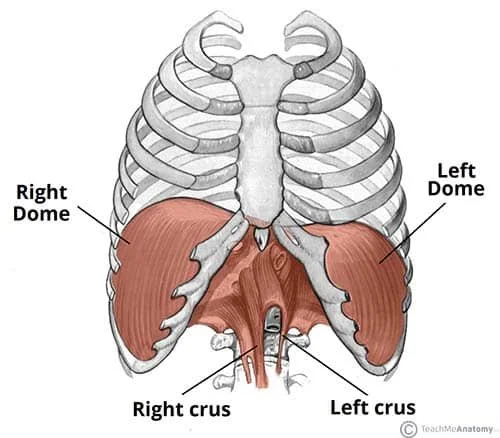
The diaphragm is a dome-shaped muscle beneath your lungs. When you inhale, its muscle fibres contract, pulling its central portion downwards. This helps increase the space inside your chest so your lungs can expand and air can enter.
At the same time, muscles between your ribs help your rib cage move. That is why an inhale can feel expansive through the sides of your chest, not just at the front.
When you breathe out quietly at rest, the diaphragm relaxes and moves back upwards as the lungs and rib cage recoil. Singing is different: the breath leaving your lungs has to be carefully regulated to support sound.
So is “breathing into your belly” wrong?
The air you breathe goes into your lungs, never your belly. But your abdomen can move during inhalation, and that movement makes anatomical sense.
As the diaphragm moves down, the organs beneath it shift slightly. If the abdominal wall is free to respond, you may notice your belly expand. It is a response to the inhale, not proof that air has travelled into your stomach.
Barbara cautions against turning that natural movement into a forced instruction to push the belly out as far as possible. You do not need to manufacture an enormous abdominal movement to breathe effectively.
Try this: feel the space changing
Place your hands gently around the sides of your lower ribs. Take an easy, unhurried breath and notice whether your hands move apart a little. Exhale without forcing the air out. Repeat a few times, keeping your neck and shoulders as comfortable as possible.
You may feel more movement in one area than another. The aim is to notice, not to perform a perfect-looking breath.
What this means for your singing
You cannot directly feel your diaphragm working in the same way you can feel your biceps. Trying to control it centimetre by centimetre can make singing more complicated than it needs to be.
Understanding the basic movement gives you a clearer picture: inhaling is about making space; singing is about coordinating the air as it leaves. That is a much more useful starting point than trying to push air into your belly.